

doi.org/10.1038/s43247-025-03157-5
Credibility: 989
#Mars
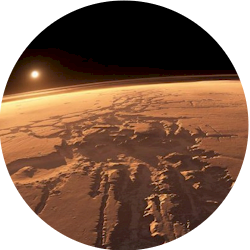
Mars once had abundant water in the distant past-rivers, lakes, and perhaps even oceans covered much of its surface

Today, the planet is a cold, dry desert, and scientists know that much of this water has been lost to space over billions of years.
The most common form of loss occurs when water vapor rises to the upper layers of the atmosphere, where solar radiation breaks down the molecules, releasing hydrogen that escapes into space.
For a long time, researchers believed this process occurred mainly during the summer in Mars’ southern hemisphere, when large global dust storms heated the atmosphere and stirred everything up, transporting water vapor to higher altitudes.
Summer in the northern hemisphere was considered a much less important period for this water loss.
Now, new research significantly changes this view.
An international team of scientists has discovered that an intense, but regional (not global), dust storm that occurred during the northern hemisphere summer managed to transport surprisingly large amounts of water vapor into the upper atmosphere.
This caused a significant increase in the release of hydrogen into space-something no one expected at that time of year.
The researchers observed this event in Martian year 37 (corresponding to 2022-2023 on Earth).
A storm located in the northwestern region of Syrtis Major grew rapidly, covering a vast area and transporting water vapor to altitudes where it does not normally reach such large quantities.
Measurements showed water concentrations up to ten times higher than normal in the middle atmosphere, and hydrogen levels in the upper atmosphere were 2.5 times higher than in previous years during the same period.

This discovery is important because it shows that localized, shorter-duration dust storms-and not just the gigantic ones that cover the entire planet-can play a significant role in the gradual loss of water on Mars.
For billions of years, these “atypical” episodes contributed to the planet’s drying out more significantly than previous climate models predicted.
As highlighted by Adrián Brines, one of the lead authors, this discovery reveals the impact of this type of storm on the evolution of the Martian climate and opens a new path to understanding how Mars lost so much water over time.
Another co-author, Shohei Aoki, reinforced that these short but intense events are an essential piece in the incomplete puzzle of the history of water on the red planet.
With this new evidence, scientists now realize that water loss on Mars was not limited to a single season or global storms.
Small (or large-scale) regional events also made a difference, helping to explain why the planet, which once possessed abundant liquid water, transformed into the arid desert we know today.
Published in 02/23/2026 18h57
Text adapted by AI (Grok) and translated via Google API in the English version. Images from public image libraries or credits in the caption. Information about DOI, author and institution can be found in the body of the article.
Reference article:
Original study: