

Comet 3I/ATLAS, a visitor from another star system, is brightening faster than scientists predicted
Until recently, it followed the expected pattern of increasing in brightness as it approached the Sun.
But in mid-September 2025, observations showed that it was becoming brighter than normal for a comet approaching the Sun.
Comets are unpredictable, so we don’t know if this increase means it will become even more visible or if it’s just a temporary flare.
Only time will tell.

Why is the comet brightening?
When a comet approaches the Sun, the water ice on its surface turns directly to gas in a process called sublimation.
This process releases dust particles that were trapped in the comet’s nucleus.
This gas and dust form the bright, diffuse coma we see, along with the comet’s tail.

Mars Flyby
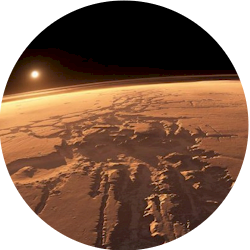
If the comet maintains this brightness, it could put on a beautiful spectacle as it passes Mars on October 3, 2025, at 4:00 AM (UTC, or 1:00 AM BrasÃlia time).
It will be closest to Mars at this time, and some probes that normally observe the red planet, such as the Mars Reconnaissance Orbiter, the European Space Agency’s (ESA) Trace Gas Orbiter, and Mars Express, will turn their cameras toward the comet.
This could provide us with incredible images of this interstellar visitor.

Where did 3I/ATLAS come from?
A team led by Xabier Pérez-Couto of the University of A Coruña in Spain has tracked the path of comet 3I/ATLAS for 10 million years.
This is only the third known interstellar object to enter our solar system, meaning it wasn’t born here, but came from another star system.
Scientists wanted to determine which star it came from or if any star altered its path as it traveled to us.
Using data from the Gaia space observatory, which has mapped billions of stars in the Milky Way for 12 years, researchers analyzed the comet’s path.
They calculated that it traveled more than 100 million astronomical units (AU, the distance between Earth and the Sun) to get here.
They identified 93 possible “encounters” with stars, 62 of which were considered significant, but none of them were close enough to alter the comet’s path.
Thus, they were unable to identify 3I/ATLAS’s star of origin.
Hubble Space Telescope images of interstellar comet 3I/ATLAS are out! These were taken 5 hours ago. Plenty of cosmic rays peppering the images, but the comet’s coma looks very nice and puffy. Best of luck to the researchers trying to write up papers for this… archive.stsci.edu/proposal_sea… ?
? astrafoxen (@astrafoxen.bsky.social) 21 de julho de 2025 Ã s 18:28
[image or embed]
Why is it so difficult to trace its origin?
Tracing the path of an object like 3I/ATLAS is very complicated.
Small uncertainties in the orbit or motion of stars grow over time, making analysis difficult.
Even so, scientists concluded that the comet likely came from the *thin disk* of the Milky Way, a region with younger objects, rather than the *thick disk*, as previously thought.
Still, the comet could be very old, perhaps formed in a very old star system, billions of years old.
What can 3I/ATLAS teach us?
The comet is like a time capsule, traveling through interstellar space for billions of years before reaching our solar system.
It can help us understand how planetary systems form.
When planets are born, rocks, gas, and dust collide to form larger bodies.
Sometimes, chunks of material, like 3I/ATLAS, are thrown out of their systems and drift through space.
Studying this comet could reveal how planets form, how materials like water and organic compounds spread through the galaxy, and how planetary systems evolve.

Can we visit the comet with a spacecraft?
The comet was discovered on July 1, 2025, and since then, many have been asking if we can send a spacecraft to study it up close.
According to astronomer Colin Snodgrass of the University of Edinburgh, there is no time to plan a specific mission for 3I/ATLAS.
However, the European Space Agency is preparing *Comet Interceptor*, a future mission that will be launched to intercept interstellar comets like this one.
How big is 3I/ATLAS?
When it was discovered, the nucleus (or central part) of the comet was estimated to be about 20 km in diameter.
In July, with data from the Vera C.
Rubin Observatory in Chile, that estimate was reduced to 10 km.
Now, with images from the Hubble Space Telescope, the size has been reduced to about 5.6 km, but it could be even smaller, perhaps just 320 meters!
For comparison, the other two known interstellar objects, *1I/’Oumuamua* and *2I/Borisov*, are smaller: *’Oumuamua* is about 200 meters across, and *Borisov* is less than 1 km across.

What is 3I/ATLAS made of?
Astronomers led by Bin Yang of the Institute of Astrophysical Studies in Chile found that the comet has a lot of water ice.
It also has a dust composition similar to D-type asteroids, which orbit farther out in our solar system and contain materials rich in carbon and silicates.
How old is the comet?
Shortly after its discovery, astronomer Matthew Hopkins of the University of Oxford suggested that 3I/ATLAS could be over 7 billion years old, older than our solar system, which is about 4.6 billion years old.
This would make it one of the oldest comets ever observed!

How was 3I/ATLAS discovered?
The comet was detected on July 1, 2025, by the ATLAS (Asteroid Terrestrial-impact Last Alert System) telescope system.
The next day, the Minor Planet Center confirmed that it is interstellar and named it 3I/ATLAS (or C/2025 N1).
The “3I” indicates that it is the third interstellar object discovered.
Its trajectory and velocity showed that it does not belong to our solar system.
The Hubble Telescope photographed it on July 21, 2025.
Where is it headed?
The comet is approaching the Sun and will reach its closest point (*perihelion*) in October 2025, at about 2 astronomical units (twice the distance from Earth to the Sun).
It is traveling at an incredible speed, about 25,000 km/h, which confirms that it is not bound by the Sun’s gravity and will escape our solar system.
Summary
Comet 3I/ATLAS is a rare visitor from another star system, shining brighter than expected and potentially putting on a beautiful show as it passes Mars on October 3. It may help us understand planet formation and the history of the Milky Way, but its exact origin is still a mystery.
Astronomers are watching closely, and who knows what else this cosmic traveler will teach us!
Published in 09/19/2025 19h05
Text adapted by AI (Grok) and translated via Google API in the English version. Images from public image libraries or credits in the caption. Information about DOI, author and institution can be found in the body of the article.
Reference article:
| Geoprocessing Drone Systems HPC |

| ERP and CRM Systems Mobile Systems AI |