

doi.org/10.1093/pnasnexus/pgag018
Credibility: 989
#Mars
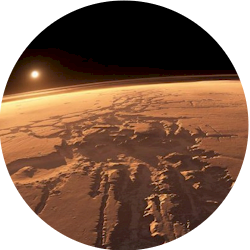
The surface of Mars and the Moon is full of enormous craters, marks left by asteroids that violently collided with these celestial bodies over billions of years
These explosions not only changed the appearance of the planets, but may also have played a surprising role in the history of life: launching chunks of rock containing living microorganisms into space, allowing life to travel from one world to another.
This idea, known as lithospheric panspermia, suggests that in very strong collisions, fragments of the planetary crust are ejected with such speed that they escape the planet’s gravity.
If these fragments contain resilient microbes, they could wander through space within the protective rock and eventually fall onto another planet-like Earth-bringing with them life forms of distant origin.
To find out if this is actually possible, researchers at Johns Hopkins University, led by mechanical engineering student Lily Zhao and Professor K.
T.
Ramesh, decided to experimentally test what happens to microbes during such an impact.
They chose an extraordinary bacterium called “Deinococcus radiodurans,” famous for being one of the toughest creatures known.
It survives radiation doses thousands of times greater than what would kill humans, withstands total dryness, extreme cold, and even the vacuum of space.
Therefore, it is considered an ideal model for imagining how life could withstand hostile conditions on Mars or during interplanetary travel.
In the laboratory, the team simulated the brutal impact of an asteroid.
They placed the bacteria between two very resistant steel plates, forming a kind of sandwich, and then hit this assembly with a third plate launched at high speed-up to about 480 km/h.
This impact generated extremely high pressure waves, reaching 3 gigapascals, the equivalent of 30,000 times the normal atmospheric pressure of Earth.
For comparison, the pressure at the bottom of the Mariana Trench, the deepest point in the oceans, is only about one-tenth of that.
The results were impressive.
At pressures of 1.4 gigapascals, virtually all the bacteria survived without any visible cell damage.
Even rising to 2.4 gigapascals-an extreme level-about 60% of them remained alive.
Some cells showed ruptured membranes and internal damage, but the reinforced cell wall structure of this bacterium seems to have made the difference, offering much greater protection than previously thought.
After the impact, scientists analyzed the gene activity of the survivors.
They discovered that they quickly entered “emergency mode”: activating mechanisms to repair DNA and other damaged cellular structures.
Within hours, they prioritized repairing what was affected, demonstrating an impressive capacity for recovery after such a violent trauma.
The study, published on March 3, 2026 in the journal “PNAS Nexus,” shows that extremophilic microorganisms like “Deinococcus radiodurans” withstand much more intense forces than previous research indicated.
This significantly strengthens the hypothesis that microbial life could have been launched from Mars during ancient impacts and traveled through space protected inside meteorites.
We know that dozens of meteorites found on Earth came from Mars-they were ejected millions or billions of years ago and ended up falling here.
If any of them carried viable microbes, the transfer of life between planets ceases to be mere speculation and becomes a real scientific possibility.
This discovery also makes us reflect on the origin of life itself on Earth.
Perhaps some of the first microorganisms that inhabited our planet arrived in Martian rocks, or perhaps the life that may exist (or have existed) on Mars has an ancestral connection to ours.
Cosmic collisions, which we have long viewed only as destructive events, may have simultaneously been bridges connecting distant worlds and helping to spread life throughout the Solar System.
In short, experiments like this demonstrate the incredible limits of biological resilience and open doors for rethinking how life can move through the cosmos-not just by chance, but propelled by the brute force of impacts that shaped the planets we know today.
??
— Rare Earth (@rareearth0) March 4, 2026
Microbes survive cosmic impacts: the possibility of life traveling from mars to other planets#Mars
The surface of Mars and the Moon is full of enormous craters, marks left by asteroids that violently collided with these celestial bodies over billions of years pic.twitter.com/uge9dEivLC
Published in 03/04/2026 06h47
Text adapted by AI (Grok) and translated via Google API in the English version. Images from public image libraries or credits in the caption. Information about DOI, author and institution can be found in the body of the article.
Reference article:
Original study: